If you’ve ever stood on a factory floor during a 24/7 production run, watching a CNC metal lathe whir with precise, rhythmic cuts that never waver, you’ve probably asked the same question we get at our shop every week: can a CNC metal lathe really be used for mass production? As a CNC metal lathe supplier who’s worked with everything from small aerospace component startups to global automotive brands for over a decade, I’ve seen this debate play out in real factory settings, not just in marketing brochures or engineering whitepapers. Let’s break this down beyond the buzzwords, because the short answer isn’t a simple yes or no—it’s a detailed, practical one that hinges on what your production goals look like, how you set up your equipment, and how you leverage the expertise of the team operating it. CNC Metal Lathe
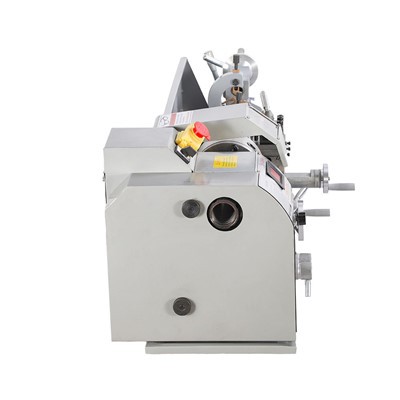
First, let’s clear up a common misconception: when people hear “mass production,” most immediately picture assembly lines with hundreds of identical parts rolling off conveyor belts every hour, like the engine blocks that built the mid-20th century automotive industry. That workhorse was the manual lathe, manned by a machinist who spent all day feeding stock, adjusting gears, and repeating the same small task over and over. But manual lathes hit a wall when mass production scaled beyond a few thousand parts—human error, operator fatigue, and inconsistent cut quality would creep in, leading to wasted material, rework, and missed deadlines. That’s where CNC metal lathes changed the game, and that’s why they’re now the backbone of high-volume production for countless industries.
Let’s start with the core technical advantages that make CNC lathes capable of mass production, advantages you don’t get with manual or even semi-automated lathes. First is consistency. A well-programmed CNC lathe will repeat the exact same cut, to within thousandths of an inch, for 10,000 parts in a row, 16 hours a day, every day. I remember a client in the medical device space who was producing 50,000 titanium bone screws a month with a manual lathe. They were throwing away 12% of parts due to human error—screws that were slightly off-thread or had a shaft diameter that varied even a hair, enough to make the screw unusable for implantation. When they switched to a two-axis CNC lathe, their reject rate dropped to less than 0.5%, and they were able to scale production to 200,000 screws a month without adding extra shifts. That’s the power of CNC for mass production: it eliminates the variable that’s always present with human operation, especially when you’re pushing for volume.
Next comes flexibility, which is a make-or-break factor for many companies that grow beyond small batch production. I know a lot of suppliers and even some machinists will argue that CNC lathes are only for long runs, but that’s not true anymore. Modern CNC lathes have controls that let you switch between part programs in minutes, not hours, and many have sub-spindles and live tooling—tools that can drill, mill, or tap while the part is still mounted. That means you can produce a complex part that would take three manual lathe operations in a single setup on a CNC lathe, cutting cycle time drastically. We worked with an aerospace parts maker a couple years ago that was producing a custom hydraulic fitting for commercial jets. Initially, they ran 1,000 parts at a time on a manual lathe, then waited a week to re-tool for the next part. With a CNC lathe that has live tooling and automatic bar feed, they now run 15,000 identical fittings in one run, and can switch to a different fitting design in 20 minutes, no re-calibration needed. That’s the sweet spot for mass production: you get the speed of dedicated equipment, but the adaptability to adjust when demand shifts or design changes are required.
But here’s the catch—CNC metal lathes aren’t a “set it and forget it” solution. You can’t just buy a lathe, plug it in, and expect it to run 24/7 for months with zero issues. Over the years, I’ve seen too many companies drop tens of thousands on a new CNC lathe, then struggle with mass production because they skipped the crucial setup and process planning steps. For example, one automotive startup came to us last year saying their $80,000 CNC lathe was only producing half the parts they’d hoped for, with regular breakdowns. When our service team showed up to troubleshoot, we found they were using cheap cutting tools designed for manual lathes, and their program was missing small details like spindle speed adjustments for different stages of the cut. We helped them optimize the tool paths, switch to high-performance carbide inserts, and adjust their maintenance schedule, and within three months, their production volume doubled, with 99% on-spec parts. That’s why, as a supplier, we don’t just sell machines—we work with clients to tailor the CNC setup to their specific mass production needs, whether that’s adding automatic loaders to reduce manual material handling, or programming multi-stage cuts to eliminate secondary operations.
Another often-overlooked factor for mass production with CNC lathes is uptime. A manual lathe might run for 80% of a shift, but a well-maintained CNC lathe can run 95% or more of the time, with only brief stops for tool changes or scheduled maintenance. But that uptime depends on two things: regular preventive maintenance and reliable support. We’ve had clients run their CNC lathes for three years straight with only minor part replacements, because they followed our maintenance guidelines—changing oil filters quarterly, inspecting the spindle monthly, and updating software as needed. On the flip side, we’ve seen a client skip maintenance, leading to a spindle failure that shut down production for a week, costing them over $100,000 in lost orders. That’s a lesson for anyone considering CNC lathes for mass production: uptime isn’t an accident, it’s a combination of quality equipment and consistent care.
Now, let’s talk about the limitations, because no tool is perfect, and that’s important to address if you’re evaluating CNC lathes for mass production. First, they have higher upfront costs than manual lathes. If you’re producing only a few hundred parts a month, a CNC lathe might not be cost-effective, because you’ll spend more on the machine than you’ll save in labor and material waste. The break-even point is usually around 10,000 parts a year, but that varies by part complexity—simple, high-volume parts might have a break-even at 5,000, while complex parts could need 50,000 or more. Second, you need skilled operators. A manual machinist can learn the basics in a few months, but a CNC operator needs to understand G-code, program setup, and troubleshooting. That means investing in training or hiring experienced staff, which adds to the overall cost. But for companies that are already producing at volumes where manual lathes are too slow or inconsistent, that cost is easily recouped.
I also often get asked about specific industries where CNC lathes for mass production really shine, and where they fall short. For example, automotive components, consumer electronics parts, medical implants, and fasteners are all perfect for CNC mass production. A company making smartphone battery casings can run hundreds of thousands of identical parts on a CNC lathe, with tight tolerances that manual machining can’t match. On the other hand, if you’re producing one-of-a-kind custom parts for prototype work, a manual or even a 3D printer might be a better fit—CNC lathes are overkill for low-volume, custom work, and you won’t see the return on investment.
Let’s also touch on recent advancements that have made CNC lathes even better for mass production. The rise of automation integration—automatic bar feeders, robotic part loaders, and lights-out manufacturing setups—means a single CNC lathe can run unattended for 8, 12, even 24 hours, producing parts while operators work on other tasks. We installed a lights-out CNC setup for a client making small hydraulic valves last year: three lathes, paired with a robotic arm that loads and unloads parts, programmed to run for 16 hours overnight. When the team came in the next morning, they had 1,200 finished parts, no manual labor involved, and all parts within tolerance. That’s the kind of efficiency that turns mass production from a slow, labor-heavy process into something scalable and profitable.
But even with all these advantages, I always advise potential clients to do a small test run before committing to full mass production. We offer trial programs where a company can send us their part design, and we run a production batch on our CNC lathes, so they can see the quality, speed, and cost for themselves. That avoids the common mistake of buying a machine without testing it for your specific part. Last quarter, a small fastener company came to us for a test run of 10,000 custom bolts, and when they saw that our CNC setup could produce them with half the reject rate and a third of the cycle time of their manual lathes, they placed an order for two lathes and an automatic bar feeder within a week. That’s the kind of practical proof that works better than any sales pitch.
So circling back to the original question: can a CNC metal lathe be used for mass production? The answer is a resounding yes—if you plan for it properly, choose the right configuration for your part volume and complexity, and pair it with the right setup, operator training, and maintenance. It’s not a one-size-fits-all solution, but for most companies producing at volumes that require consistent quality, speed, and scalability, it’s far superior to manual or semi-automated lathes.
At our shop, we’ve built our business on helping manufacturers navigate this exact question. We don’t push a one-size-fits-all CNC lathe to every client—we ask about your current production volume, your target volume, the complexity of your parts, and your budget, then recommend the setup that will actually deliver results for your mass production goals. Whether you’re a startup looking to scale from prototype to 10,000 parts a month, or an established brand looking to streamline your high-volume production line, we have the CNC solutions, support, and expertise to help you succeed.
If you’re curious how a CNC metal lathe could work for your mass production needs, we’re here to walk through your specific project, answer questions, and even run a test batch to show you the results. There’s no pressure, no complicated sales pitch—just practical advice from a team that’s worked in CNC machining for years, and knows what it takes to turn a production goal into a successful reality.
Long Bed Wood Lathe References
ASM International. (2007). Metals Handbook: Volume 16: Machining. ASM International.
Groover, M. P. (2020). Automation, Production Systems, and Computer-Integrated Manufacturing (5th ed.). Pearson.
National Institute of Standards and Technology. (2018). Metrology for Precision Machining: Ensuring Quality in High-Volume Production. U.S. Department of Commerce.
Smid, P. (2008). CNC Programming Handbook (2nd ed.). Industrial Press, Inc.
YS Machine Tools Co., Ltd.
We’re well-known as one of the leading cnc metal lathe suppliers in China, featured by quality products and good service. Please rest assured to buy customized cnc metal lathe at competitive price from our factory. Contact us for more details.
Address: 300 Sandusky st, Ohio, 43611, USA
E-mail: yishoumachinetools@gmail.com
WebSite: https://www.ysmachinetool.com/
